All Posts (9)

Sort by

A Collection of Short Crime Fiction Stories

11032205881?profile=originalThe KCRW Production "Mean Streets USA" is a collection of short crime fiction stories, a highly-produced series, recorded and produced at KCRW. It features detective stories by contemporary and classic mystery writers like Walter Mosley, Sue Grafton and Michael Connelly, read by Stacy Keach, Sharon Lawrence, Meschach Taylor, Tony Plana and others.


These were recorded off the internet, but the quality is decent.


MS 1 The Angry Man by Ross Macdonald read by Stacy Keach part 1

MS 2 The Angry Man by Ross Macdonald read by Stacy Keach part 2

MS 3 Silver Lining by Walter Mosley read by Meshach Taylor

MS 4 Serpents Dance by Jim Fusilli read by Tate Donovan

MS 5 The Parker Shotgun by Sue Grafton read by Harriet Harris

MS 6 The Dead Their Eyes Implore Us by George P. Pelecanos read by Tony Plana

MS 7 Cielo Azul by Michael Connelly read by John Michael Higgins


Read more…

11032206688?profile=originalDuring Yuletide, Holmes and Watson face several Dickensian Londoners, a dusty hat, a famous gem - and a goose!

Craig Wichman plays the Great Detective, and John Prave, the Good Doctor. The cast features Emma Palzere, Joseph Franchini, Dan Renkin, Clyde Baldo, and Soprano Soloist Bernadette Fiorella (New York City Opera). Original music by Frank Spitznagel. Sound effects by Sue Zizza, Mr. Baldo, and the cast. Engineers, Chip Fabrizi and Dominick Barbera.

THE BLUE CARBUNCLE (A Christmas Adventure of Sherlock Holmes)

Read more…

OTRR Library Annual Christmas Drive

11032206654?profile=originalJust a note if any missed the OTRR Library Annual Christmas Drive. Below is the post on the Old Time Radio Researchers blog. I know a lot of our members enjoy the free OTRR Library from time to time, and if you can give a couple of dollars please help out the Group. Mention you are a member of Times Past and show our thanks.

From OTRR


"It’s that time of year again, when we come to you with our annual fund raising drive.

If you use and enjoy the library, you know it’s free to all to use. No bandwith charges, no individual episode charges or any of that other silly stuff that the MP3 FTP sites charge. We are totally free and even if you can’t make a contribution, you can still download to your heart’s content.

At Christmas, we ask all those of you who’ve enjoyed the library to help support the costs of the server on which the Library is hosted. Just put a couple of dollars in a envelope and send it to -

Jim Beshires
123 Davidson Ave
Savannah, GA 31419

Or if you’d rather contribute via paypal, send it to beshiresjim@yahoo.com."

Read more…

Why Drinking Tea Was Once Considered A Dangerous Habit

by Allison Aubrey (NPR)

tea-dc99236d99f79af7c58e33f67d40b47ca3af2b85-s4.jpgTea a dangerous habit? Women have long made a ritual of it, but in 19th century Ireland, moral reformers tried to talk them out of it. At the time, tea was considered a luxury, and taking the time to drink it was an affront to the morals of frugality and restraint.

Given tea's rap today as both a popular pick-me-up and a health elixir, it's hard to imagine that sipping tea was once thought of as a reckless, suspicious act, linked to revolutionary feminism.

Huh? Well, the feminist complaints came from 19th century, upper class Irish critics who argued that peasant women shouldn't be wasting their time — and limited resources — on tea. If women had time to sit down and enjoy a tea break, this must mean they were ignoring their domestic duties and instead, perhaps, opening the door to political engagement or even rebellion.

"Drinking tea was thought to threaten traditional ways," explains researcher Helen O'Connell of Durham University in the UK. In the 1800s, tea was an affront to the virtues of frugality and restraint, which underpinned rural Irish culture.

In a new paper published in the journal Literature and History, O'Connell explores the angst about tea by combing through popular pamphlets — or short works of fiction — published in the 1800s. The pamphlets were published by reformers who were trying to weave tales of morality and clean-living into story form.

In one pamphlet, "Cottage Dialouges," written by the Irish Quaker author and reformer Mary Leadbeater, a dialogue between two women makes it clear that tea-drinking was considered a lavish, irresponsible behavior that could be habit-forming. Though the characters don't know the language of addiction, they use the phrase "hankering after it" — as if to suggest that once you'd had your first cup of tea, it would impossible to stop or control your longings. Adding to this suggestion is the fact that tea was sold at liquor stores.

The reformers' campaign against tea took on another moral outrage too: slavery. Since tea was typically sweetened with sugar at the time, reformers in Ireland tried to convince people that tea-drinking was akin to drinking the blood of slaves who were forced to work the plantations where sugar was produced.

O'Connell says clearly, in the end, the campaign against tea was not successful. Consumption of tea continued to grow steadily during this period.

To us, the campaign against tea, particularly the suggestions it may lead to revolutionary feminism, may seem crazy.

But in some ways, O'Connell says, "contemporary culture has all of these ideas about food which might appear ludicrous in time to come."

Any examples come to mind? "Maybe organic food, I don't know," O'Connell says. Or maybe the way we obsess over gluten. "Working on this project has made me a bit more critical of food discourse," she says. "Our passions and beliefs sometimes take over."
Read more…

It's A Wonderful Life Radio Play

Just returned from seeing a little theater group called the "Bread and Circus Theater Company". They performed  "It's A Wonderful Life." as a live radio play. The year was 1946. The cast was all dressed in vintage clothing. They performed to microphones. Read from scripts. The actors performed multiple roles. Sound effects performed live on stage. A couple of adds from sponsers, hair cream and soap. Even had "On Air" and "Applause" signs for the audience. All and all a nice trip into the past to get the feel of what it must have been like to see a radio drama performed. If anyone gets the opportunity to see a performance from a theater group; By all means, make haste.

Read more…

War-Era Food Posters: Patriotism and Food

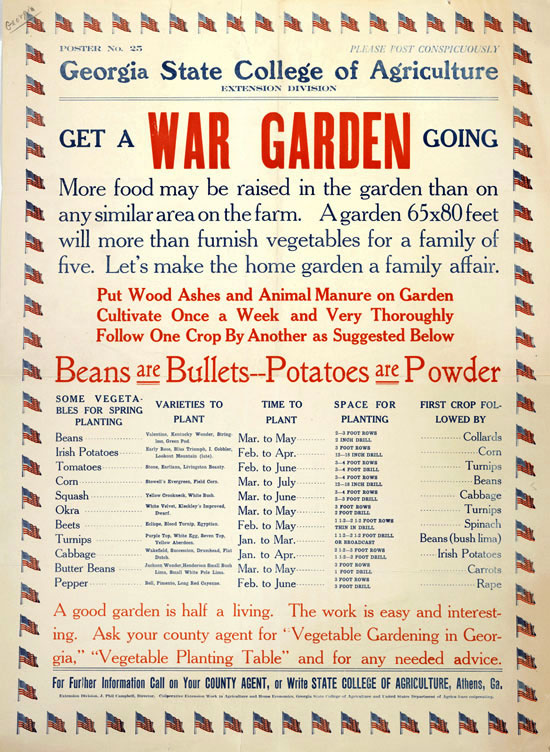
ch1big3.jpg?width=250As evidenced by the subjects of government posters, food was every bit as important to the war effort as troops, weaponry and factories.  From the farm to the front, food production, distribution, preservation and conservation played a vital role in war times.  Significantly, the language of the posters may even speak of food in terms normally reserved for weapons.  "When Beans Were Bullets", An Exhibition of Posters by Cory Bernat". War-Era Food Posters from the Collection of the National Agricultural Library features a collection of government posters that highlight the subject of food.  The subjects range from canning to Victory Gardens.  Lovers of American wartime history might appreciate this exhibit as much as I did.

"An Exhibition of Posters by Cory Bernat":  http://www.good-potato.com/beans_are_bullets/


  Additional Resources:

Yours ever in appreciation of history, Cat

Read more…

Recent

Blog Topics by Tags

Monthly Archives